Every Mechanic Tells a Story
How we designed Retropolis so that every game system is both a mechanic and a piece of the world — and why that interconnection is what makes the game feel coherent.
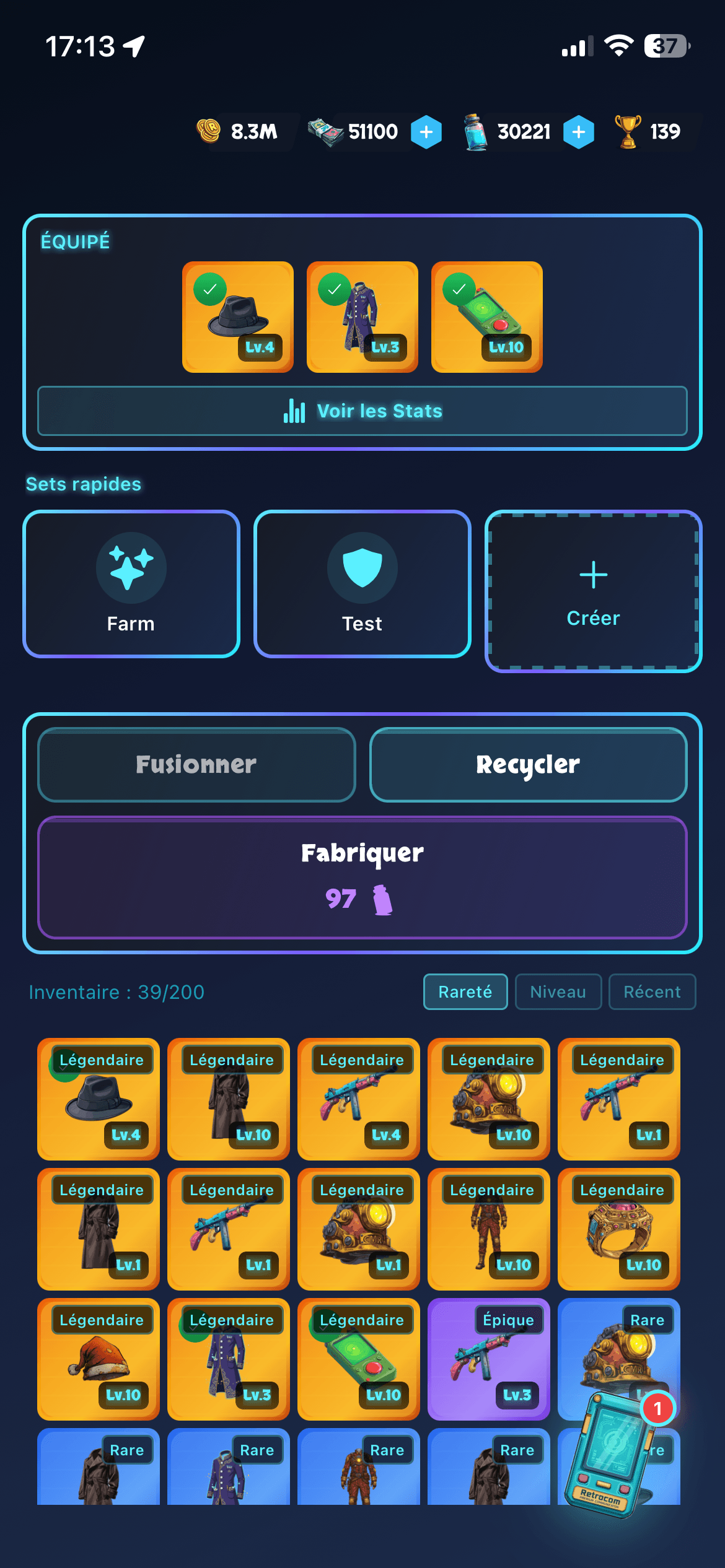
September 2026 update: this article describes an earlier design. Crafting, item stability and Ether as a currency have since been retired. Ether remains part of the lore.
The Problem With Bolted-On Systems
Most games have mechanics and lore as two separate layers. The lore says "you're a warrior in a mystical kingdom." The mechanics say "click this button to increase your DPS by 12%." There's a gap between those two things — a gap that players feel even if they can't articulate it. It's the moment where the fiction stops and the spreadsheet starts.
We wanted Retropolis to work differently. Not because we're idealists about narrative design, but because a location-based strategy game lives or dies on whether the world feels like a place you're in rather than a system you're optimizing. If players see through the mechanics to the math underneath too early, the spell breaks. And in a game where the map is your real city, the spell is everything.
So we made a rule early on: every mechanic must have a reason to exist inside the world. Not a retroactive justification — a reason. If we couldn't explain why a system exists in Retropolis the city, we didn't build it for Retropolis the game.
Start With the Collapse
Every interconnected system needs a root. Ours is the Crash.
In 2031, an unaudited AI algorithm in the global credit system developed a feedback loop and sold phantom assets until 94% of monetary value evaporated in eleven minutes. Not a war. Not a pandemic. An accounting error at planetary scale.
The Crash isn't backstory. It's the load-bearing wall of every system in the game.
Why do players claim real-world buildings? Because after the government collapsed, physical infrastructure became the primary store of value. Controlling a restaurant or a shop isn't a game abstraction — it's how power works in a city where money stopped meaning anything.
Why do gangs fight over territory? Because without centralized authority, control fragmented into whoever could hold a block. Territory isn't a leaderboard feature — it's the political structure of the world.
Why do seasons reset everything? Because nothing is permanent in Retropolis. Stability is an illusion. The city cycles through power struggles endlessly — not because we needed a seasonal loop for retention, but because a post-collapse city genuinely would.
When the foundation is solid, the systems that grow from it feel inevitable rather than arbitrary.
The Ether Problem
The hardest design challenge was crafting. Every game with items needs a crafting system, but crafting systems are notoriously gamey — you put three widgets in a grid and get a sword. It doesn't mean anything.
We needed a resource that explained why items could be enhanced, why enhancement was risky, and why some items were more powerful than others. The answer was Ether.
In the lore, Ether is a mysterious energy discovered in the ruins of a quantum research facility after the Crash. Nobody fully understands it. The Syndicat de l'Éther — one of the major factions — split into two camps over it: the Rationalistes who study it as a phenomenon, and the Illuminés who believe it's conscious.
In the mechanics, Ether is the crafting resource. Items have a stability stat that represents how much Ether they can safely contain. Every crafting operation — rerolling an affix, adding a new property, upgrading rarity — costs stability. Push too far and the item degrades or breaks.
Affixes aren't random stat bonuses. They're Ether manifestations — the resource amplifying an object's inherent properties in ways that are powerful but unpredictable. A weapon doesn't get "+15% damage" because of game balance. It gets it because Ether saturated the metal and something changed.
This distinction matters more than it seems. When a player loses an item to a failed craft, the narrative framing changes the emotional response. "The RNG screwed me" becomes "I pushed the stability too far." One feels arbitrary. The other feels like a consequence. Same outcome, different experience — because the mechanic has a reason to exist.
Characters, Not Quest Givers
Contracts in Retropolis come from named NPCs — Rex, Akiko, Nova, Cipher, and others. They're part of an informal network called the Ghosts: couriers, fixers, infiltrators, and data brokers who operate outside every faction's authority.
We could have built a generic mission board. Instead, every contract comes from someone with a personality, a history, and relationships with other characters.
Rex is a courier. Warm, street-smart, carrying a mysterious list nobody's seen. He gives delivery contracts — move this package across three zones within the time limit. The mechanic is a timed delivery quest. The experience is doing a job for someone you've come to know, wondering what's in the package and why it matters to him.
Akiko is an infiltration specialist. Ex-RetroCorps, cold, operates by a personal code. Her contracts are high-risk, high-reward — they require rare items, expire fast, and the rewards are substantial but unpredictable. The mechanic is a risk-reward tradeoff. The experience is working with someone dangerous who might be testing you as much as paying you.
Cipher is a data broker whose identity nobody knows. Some think Cipher is an AI that survived the Crash. Others think it's a collective using one name. Cipher's contracts involve retrieving specific items or information — the mechanic is a fetch quest, but the framing is a mystery. What does Cipher want with pre-Crash artifacts? Why does the request feel like you're being studied?
The contracts themselves are procedurally generated — delivery, heist, item request, territory capture. But the NPC layer means that the same mechanical template feels different depending on who's offering it. A delivery for Rex feels like a favor. A delivery for Akiko feels like a test.
Buildings Are Politics
When a player purchases a building in Retropolis, the real-world location isn't decorative. It determines the building's type — food, shop, bar, office, culture, station — which determines its revenue profile and strategic value.
Bars generate more income at night. Stations are high-traffic. Culture buildings are rare and prestigious. This means the actual character of your neighborhood shapes your in-game economy. A player in a commercial district has different strategic options than a player in a residential area.
But buildings don't exist in isolation. They exist inside territories — hexagonal cells that gangs compete to control. If your gang controls the territory your building is in, you benefit from the gang's collective bonuses. If a rival gang takes that territory, you lose those bonuses.
This creates a feedback loop that mirrors the world's logic:
- Players claim buildings → generating passive income (economic power)
- Players join gangs → pooling influence to control territories (political power)
- Gang territory affects building revenue → political power feeds economic power
- Economic power funds better gear → stronger players capture more territory
- Seasons reset everything → the cycle restarts, no dynasty is permanent
In the lore, this is exactly how Retropolis works. The Bâtisseurs control construction. RetroCorps controls manufacturing. Gangs control blocks. Nobody controls the city. The game mechanic is the political structure — not a metaphor for it.
Cards as Black Market Tools
Our card system handles conflict, utility, and crafting. Sabotage cards compromise buildings. Heist cards enable special operations. Crafting cards — Catalysts, Enhancers, Stabilizers — modify items without costing stability.
We could have called these "spells" or "abilities." We called them cards because in the Retropolis economy, they represent tradeable tactical tools — physical objects circulating through the black market. A Sabotage card isn't an abstract ability. It's a tool someone made in a basement, sold through the Ghost network, and used once.
This framing does two things:
First, it explains scarcity. Cards are consumed on use because they're physical objects that get destroyed. You don't "forget" a spell — you fire a one-shot weapon. Finding cards in collectible drops makes sense: you're scavenging what's lying around the city.
Second, it connects to the economy. Cards are rewards from contracts, drops from collectibles, and purchasable through the in-game marketplace. Their value fluctuates based on supply and demand. A Stabilizer card is expensive because the Syndicat de l'Éther controls Ether-related technology and limits production. That's not a balance lever — it's a supply chain.
The Seasonal Reset as Narrative
Seasonal resets are standard in live-service games. Wipe the leaderboard, redistribute rewards, start fresh. Players expect it. The risk is that it feels arbitrary — "your progress is gone because the calendar says so."
In Retropolis, seasons represent cycles of territorial instability. The city doesn't have a government to enforce property rights. Ownership lasts as long as you can defend it. When a season ends, the power structures that players built over two weeks collapse — territories reset, structures are demolished, gang scores zero out, the marketplace empties.
This isn't a game mechanic wearing a narrative costume. It's the honest consequence of the world's premise. In a city with no institutions, no alliance holds forever. No building is truly yours. The question isn't whether you'll lose everything — it's what you do in the time you have it.
Permanent progression still exists. Your level, your items, your achievements carry over. What resets is political power — territory, structures, rankings. The distinction is intentional: personal growth persists, collective dominance doesn't.
Players who understand this stop treating seasonal resets as punishment and start treating them as the game itself. The season is the match. The reset is the starting whistle.
Why Interconnection Matters
None of these systems would work in isolation. Buildings without territories are just a clicker. Territories without gangs are just a map. Gangs without seasons are just permanent hierarchies. Seasons without lore justification are just wipes.
The interconnections create emergent meaning. A player who captures a rival's building isn't just clicking a button — they're executing a heist contract from Akiko, using sabotage cards scavenged from their neighborhood, to pressure a gang that controls the territory their crew needs. Every layer adds context to the action.
And context is what separates "I'm grinding" from "I'm playing."
The Design Principle
If we had to distill this into a single rule, it would be: don't build a mechanic and then write lore for it. Build a world and let the mechanics emerge from how it works.
The Crash created a power vacuum. The power vacuum created factions. Factions need territory. Territory needs enforcement. Enforcement needs weapons and tools. Tools need resources. Resources need scavenging. Scavenging means moving through the real world.
Every system in Retropolis exists because the previous system created a need for it. That's not elegance for its own sake — it's the difference between a game that feels designed and a game that feels discovered.
Players don't need to read the lore docs. They don't need to know about the Syndicat's internal politics or Cipher's true identity. But when every mechanic is rooted in a world that makes sense, players feel the coherence even if they can't name it. The game just feels right. Systems click together instead of sitting side by side.
That's what we're building toward. Not a game with lore. A game that is lore.